




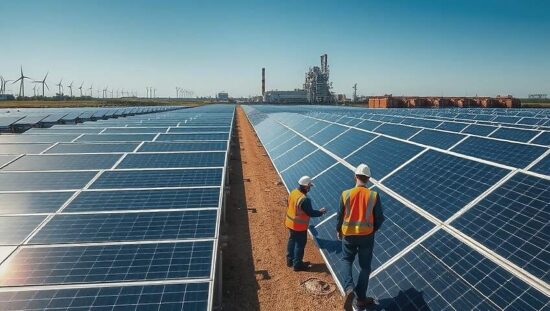
In 2025 Germany generated 438.2 billion kilowatt-hours (kWh) of electricity that was fed into the grid. According to provisional figures released by the Federal Statistical Office (Destatis) on Friday, this represents a 1.4 % increase over the previous year. Renewable sources accounted for 58.6 % of the electricity fed into the grid, a share that has remained above 50 % since 2023 (59.5 % in 2024). The amount of power produced from renewables was almost unchanged from 2024 at 256.9 billion kWh, a decrease of 0.1 %. In contrast, conventional generation rose by 3.6 % to 181.3 billion kWh, making up 41.4 % of the supplied electricity (40.5 % in 2024).
Wind power output fell by 3.6 % to 131.3 billion kWh, and its share of total generation slipped from 31.5 % in 2024 to 30.0 % in 2025. Nevertheless, wind remained the largest individual source of domestic electricity. Photovoltaic generation increased sharply by 17.4 % to 70.1 billion kWh, representing 16.0 % of total domestic production, a record for any full year since data collection began in 2018. Hydroelectric output dropped significantly by 22.5 % to 15.8 billion kWh, or 3.6 % of overall production.
Coal generated 96.8 billion kWh in 2025, a 0.5 % decline from the previous year, and its contribution to domestic production fell to 22.1 % from 22.5 % in 2024. Natural‑gas‑derived electricity rose 10.2 % to 70.6 billion kWh, accounting for 16.1 % of total production. Like photovoltaics, this marked the highest output and share since 2018. After a dip to 11.5 % in 2022 triggered by the Russian attack on Ukraine and tightening gas markets, the share of gas power climbed to 13.7 % in 2023 and 14.8 % in 2024 before reaching 16.1 % in 2025.
Import of electricity into Germany fell by 2.6 % to 79.6 billion kWh in 2025 from 81.7 billion kWh in 2024, while exports rose 8.7 % to 60.2 billion kWh (from 55.4 billion kWh in 2024). Germany thus continued its third consecutive year of net imports; the import surplus decreased from 26.3 billion kWh in 2024 to 19.4 billion kWh in 2025.
A long‑term trend shows a clear shift in domestic electricity generation. Until 2022 conventional fuels dominated, but since 2023 renewables have supplied more electricity each month than conventional sources. In 2018, the year the series began, renewable generation totaled 207.5 billion kWh, nearly a quarter less than in 2025, while fossil‑fuel output was 355.8 billion kWh, cutting to 175.0 billion kWh in 2024. Conventional output in 2025 modestly rebounded to 181.3 billion kWh.
Despite the quarterly growth, total domestic generation in 2025 remained considerably lower than in the series’ inception: 438.2 billion kWh versus 566.8 billion kWh in 2018, a decline of 22.7 %. Between 2018 and 2022 Germany had consistently exported more electricity than it imported, but this reversed in 2023. Since then imports have exceeded exports, creating a persistent import surplus.
The overall amount of electricity available and demanded in the German grid-calculated as domestic supply plus imports minus exports-was 457.6 billion kWh in 2025, 11.7 % below the 518.0 billion kWh of 2018, according to the Federal Office.