




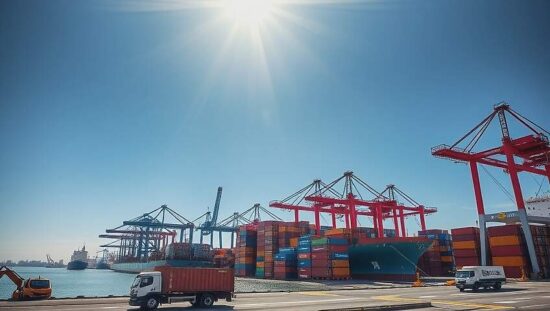
German seaports handled a total of 284.4 million tonnes of cargo in 2025, up 3.8 % from the 273.9 million tonnes recorded in 2024. Inbound traffic from abroad grew 5.3 % to 171.1 million tonnes, while outbound exports increased only 0.5 % to 103.7 million tonnes. Domestic freight, which rose 15.7 %, accounted for just 9.6 million tonnes and a small share of overall movement. Hamburg remained the busiest port with 99.8 million tonnes (+2.9 %); it was followed by Bremerhaven (46.9 million tonnes, +10.4 %), Wilhelmshaven (35.5 million tonnes, +2.7 %), Rostock (24.9 million tonnes, +7.2 %) and Lübeck (15.8 million tonnes, -0.4 %).
The largest cargo group was “non‑identifiable goods” – mainly container loads without detailed description – which accounted for 87.9 million tonnes or 30.9 % of the total. Fossil fuels followed at 40.5 million tonnes (14.2 %), then ores, stones and clays at 31.1 million tonnes (10.9 %), and chemical products at 20.2 million tonnes (7.1 %). Inward fossil‑fuel traffic was 39.8 million tonnes, slightly down 1.2 % from 2024. Of this, oil imports fell 10.8 % to 25.4 million tonnes, coal rose 2.6 % to 7 million tonnes, and gas jumped 49.1 % to 7.4 million tonnes.
In terms of suppliers, the United States was by far the biggest source of sea‑borne natural gas, delivering 6.5 million tonnes in 2025 – a 51.8 % increase on the previous year. US oil imports fell 23.6 % to 5.6 million tonnes but remained the largest provider, displacing Norway, whose exports dropped 27.7 % to just under 5.6 million tonnes. US coal imports were 2 million tonnes (+0.1 %) and again topped the list of suppliers. Overall German‑US maritime traffic fell 3.6 % to 28.7 million tonnes, yet the United States remained Germany’s leading sea partner. Norway followed with 26.3 million tonnes (+1.8 %), Sweden 24.6 million tonnes (+3.6 %) and China 19.7 million tonnes (+3.1 %); together these four countries contributed a little more than one‑third of all German seaport traffic. Traffic with EU members reached 99.4 million tonnes, an increase of 3.3 %.
Container throughput totaled 15 million TEU, a 12.4 % rise over 2024. China represented a fifth (3 million TEU), followed by the United States at 1.3 million TEU (8.7 %). Container flow to China grew 12.1 %, whereas traffic to the US slipped by 2.4 %. Container traffic within the EU rose 13.1 % to 4.1 million TEU, the largest share of German port container movement in 2025.
Sea traffic to the Gulf states was comparatively modest: 4 million tonnes, or 1.4 % of total cargo. Exports and imports with Bahrain, Iraq, Iran, Qatar, Kuwait, Oman, Saudi Arabia and the United Arab Emirates summed to that amount. The most significant flows were to Oman (inbound 1.4 million tonnes, outbound 1.1 million tonnes, with nearly all non‑identifiable container cargo at 0.9 million tonnes), to the UAE (inbound 1.2 million tonnes, outbound 1 million tonnes, including 0.2 million tonnes of furniture) and to Saudi Arabia (inbound 0.9 million tonnes, outbound 0.5 million tonnes, mostly liquid mineral oil products). Kuwait and Qatar supplied only liquid minerals as well, with 0.3 million and 0.2 million tonnes respectively. Notably, no sea cargo moved to Germany from Iran in 2025.
Because many goods from Gulf countries first arrive in large foreign ports-such as those in the Netherlands, France, Italy and Belgium-before reaching European destinations, maritime blockades in the Middle East can indirectly affect Germany’s supply chain.