



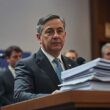

In an op-ed published in the “Rheinische Post” (Saturday edition), former foreign policy advisor to German Chancellor Angela Merkel, Christoph Heusgen, and former US Ambassador to Germany and New Jersey Governor, Philip Murphy, shared their concerns regarding the current direction of US foreign policy under Republican President Donald Trump.
The two men argue that the transatlantic relationship is in a state of crisis. They specifically criticize President Trump for treating Europe as an adversary, questioning America’s commitment to NATO, and making threats, such as the potential annexation of Greenland.
Heusgen and Murphy further criticized the President’s domestic actions, noting that he is undermining the separation of powers by exerting pressure on the judiciary, pushing a Congress controlled by his own faction towards the fringes, and removing experienced civil servants while filling federal agencies with loyalists. Yet, they also observed signs of growing public resistance within the United States, suggesting Americans are beginning to experience the consequences of erratic foreign policies-particularly visible in rising public opposition to stringent immigration measures.
Looking ahead, Heusgen and Murphy expressed confidence in the Democratic Party’s ability to reclaim control over the House of Representatives during the midterms in November, and perhaps even the Senate. They believe this shift would place noticeable limits on the MAGA agenda. They painted a picture of a credible path toward a democratic presidency in 2028, leading to a return to cooperation rather than confrontation across the Atlantic.
They asserted that a future Democratic presidential administration would highly likely reaffirm the transatlantic alliance. Following President Barack Obama’s 2016 Hannover speech, they believe such a leader would recognize that a strong Europe is fundamentally in American interest, while also striving for more constructive trade relations with the European Union.
Aside from US politics, the authors offered advice to the German federal government with respect to the UN Security Council. They suggested that the United States and Germany could jointly spearhead an initiative to reform the Council. Given current geopolitical realities, the long-standing German claim to a permanent seat is proving increasingly difficult to sustain, and they proposed that a model incorporating semi-permanent seats might offer a more realistic way to achieve the necessary two-thirds majority in the General Assembly.
Finally, Heusgen and Murphy issued a stark warning against unilateral actions by the United States. While it may be tempting for the US to act independently, they maintained that in the long term, both nations would be best served by upholding the rule of law rather than allowing the dictates of the strongest power to prevail. They concluded with a sober reminder: “History has shown where this path leads-to catastrophe”.