




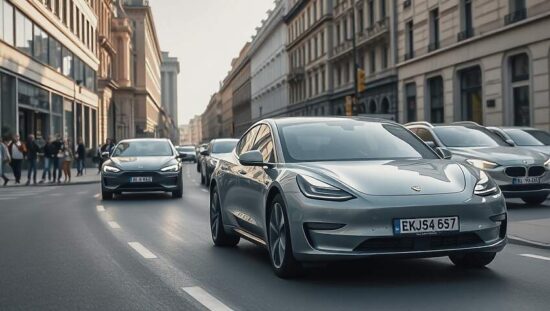
German car manufacturers have strengthened their position in the European electric mobility market over the past year. According to data reported by Funke Media Group’s newspapers from the German Association of the Automotive Industry (VDA), in 2025, every second newly registered electric car in the EU originated from a German manufacturer, more than doubling the domestic industry’s market share since 2016. Furthermore, their market share in plug-in hybrids stood at 58.6 percent in 2025.
When considering both battery electric and hybrid vehicles combined, German brands even have a better market standing in several countries for this segment than they do with traditional combustion engines. For instance, in the Netherlands, Italy, and France, their market share in EVs and hybrids accounted for a significantly higher percentage of all vehicles in 2025. Manufacturers have notably expanded their positions recently in several European nations. Their market share for partially or fully electric vehicles in Japan was more than triple that of the overall market (17.5 percent versus 4.5 percent). Similarly, in the US (13.3 percent versus 8.1 percent) and South Korea (13.9 percent versus 12.0 percent), their segment share exceeded the overall market share.
However, a major concern for the industry remains sales in China. The already small market shares of German automakers for electric and hybrid vehicles in the People’s Republic of China saw a distinct drop from 2024 to 2025. For plug-in hybrids, German manufacturers managed only a 0.5 percent market share, while for pure battery electric vehicles, it was 2.5 percent.
Against this backdrop, VDA President Hildegard Müller advocates for viewing the industry situation in detail. “Debate and arguments too often fall into black and white schemes” Müller told the funke Media Group. She confirmed that the automotive industry is restructuring itself, drawing on creativity and investment to drive towards a climate-neutral mobility of the future. “Our manufacturers have a higher proportion in the E-mobility segment than in the overall market in many markets” she noted.
At the same time, she strongly urged politicians to make Germany a more attractive location for production. “When it comes to the competitiveness of our location, neither empty words nor negative speculation helps” stated the VDA President. For the necessary decisions, she stressed looking at figures, data, and facts: “In all rankings, whether concerning tax burden, administrative effort, or even labor costs, Germany has recently been ranked poorly. We are facing a massive location crisis affecting the entire German industry”.
She further stated that the belief that politics can make better economic decisions or assess technological developments than companies, which have done so successfully for decades, has “failed”. Therefore, the time has come to initiate a comprehensive and decisive course correction.