



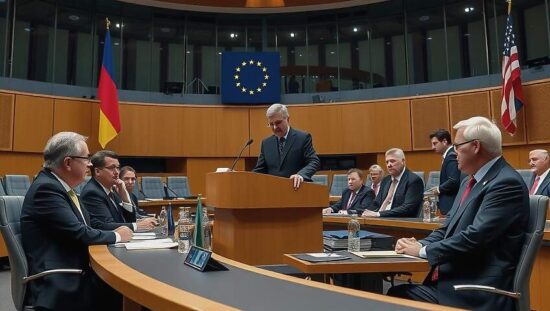
The chairman of the European Parliament’s Trade Committee, Bernd Lange of the SPD, has made the approval of the planned customs agreement with the United States contingent on concrete guarantees from Washington that the agreed tariff rates will not be exceeded.
In an interview with “Der Spiegel”, Lange said that on Monday the committee will discuss whether, given the latest developments, a vote on reducing tariffs for U.S. products can still take place as originally planned. He added that there is “no certainty at all” that the U.S. side will uphold the deal. “We would likely put a hold on the matter and wait for legal certainty” Lange explained.
The agreement between European Commission President Ursula von der Leyen and President Donald Trump was reached in the summer during a summit in Turnberry, Scotland. Lange pointed out that the new tariffs would infringe on the Scottish deal. According to U.S. law, the originally announced ten percent tariffs are additional duties; they must be added to products that are already subject to tariffs. This would create a burden for many items that exceeds the 15‑percent maximum agreed in Turnberry. The situation worsens if Trump follows through on his announcement and demands 15 percent instead of the initially announced ten percent.
“We need a clear legal framework from the United States” Lange demanded. Washington could define appropriate exceptions to the global tariffs so that the agreement would hold. “There is absolute chaos at present because of the U.S. announcement, and many questions need answering” he said.
Moreover, Lange insists on a stable and reliable commitment from the U.S. that what is happening now-namely, tariff increases-will not happen again, and that there are no expectations for further additional tariffs in the future. Without such assurances, he warned, the European side cannot continue to process the deal.
The European Parliament’s Trade Committee is scheduled to vote on Tuesday on the EU’s reciprocal actions in the tariff arrangement, chiefly the removal of many tariffs that currently apply to U.S. agricultural and industrial exports to the EU.
Metin Hakverdi, the German government’s Trans‑Atlantic Coordinator and a member of the SPD, described the Supreme Court decision as a domestic political setback for Trump in a crucial election year ahead of the U.S. mid‑term elections. “I was just in the deep South” he told “Der Spiegel”. “Many Republicans disagree with this tariff policy”. Hakverdi added that the newly announced tariffs could only be imposed temporarily, which would curb this key trade‑policy tool. “We are coordinating the European response closely” he said. “Unity in Europe is the decisive factor”.