




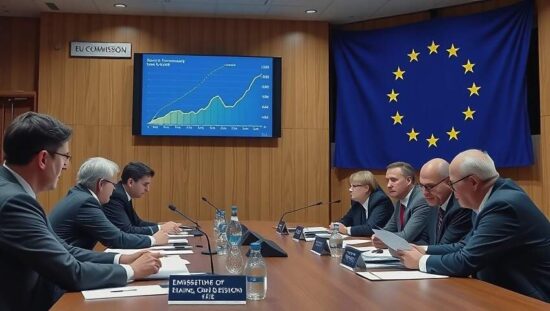
The European Commission plans to weaken the EU Emissions Trading System for the energy sector and industry (EU‑ETS‑1), a story reported by the Handelsblatt’s mid‑week edition and based on statements from senior EU officials. The cap‑and‑trade mechanism is the EU’s main climate‑policy tool, because the annual number of CO₂ certificates determines the maximum amount of emissions allowed in the covered sectors.
Under the current rules the volume of permits is cut by 4.4 % each year, which means the cap will be exhausted by 2039. The Commission’s proposal would slow this decline, effectively increasing the number of certificates that remain available and allowing higher emissions for a longer period.
The proposal also extends the period during which free certificates are distributed. The Commission previously intended to reduce free allocations sharply from this year onward and to eliminate them entirely for some sectors starting in 2034.
In Germany, revenue from the carbon‑pricing system goes to the Climate and Transformation Fund, which finances renewable‑energy expansion, electric‑mobility programmes, building‑energy‑efficiency upgrades, hydrogen projects, and climate‑friendly industrial processes. A smaller trading windfall would therefore reduce funding for these additional climate‑protection measures.