




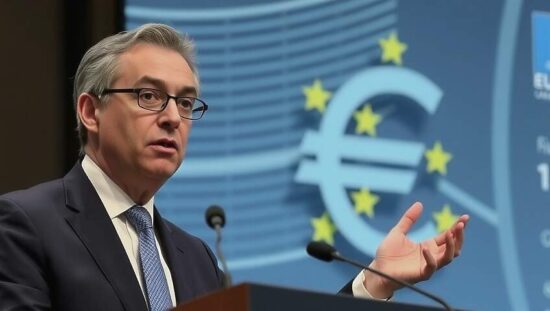
ECB Director Piero Cipollone defended the planned launch of a digital euro, arguing that the controversy stems mainly from widespread misinformation. He dismissed claims that the European Central Bank seeks to dictate how people spend their money as nonsense and stressed that no one will be compelled to use the digital euro.
Cipollone said the new currency and a pan‑European payment system are part of a strategy to strengthen European sovereignty against the United States. He illustrated this by referring to judges of the International Criminal Court, whose American cards had been blocked by U.S. authorities. Because their payment options in Europe were limited by Visa and Mastercard, they couldn’t transact normally across the euro area. A digital euro would have allowed them to carry out payments throughout the entire Eurozone without interruption.
Addressing accusations that the digital euro competes with private providers, Cipollone argued the opposite: it establishes a European standard. By creating a shared infrastructure, services such as Wero-a new payment platform launched by several European banks-could operate everywhere in Europe. He likened it to a public railway network on which any rail operator can run trains to any destination. Such an infrastructure would make it easier for private European payment providers to expand and serve customers throughout the Eurozone.
Critics claim that a digital euro could enable selective blocking of purchases. Cipollone refuted this, explaining that the Eurosystem has no authority to block transactions. When a payment is issued, the system reserves the required amount but does not track individual units of money. Controlling spending would require marking each digital “banknote” which the ECB and any other entity cannot do. The system records only the transaction amount and encrypted identifiers for payer and recipient, leaving the identities and spending habits of users anonymous.
Cipollone considered the European Parliament’s skeptical stance toward the digital euro “dangerous”. He warned that every delay only deepens Europe’s reliance on foreign payment systems.