




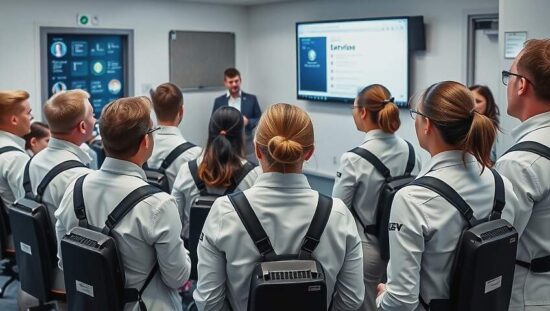
Directly before the major safety summit of Deutsche Bahn (DB) on Friday, the group had already made some concrete decisions. Body‑camera training is now compulsory for all 5,200 customer‑service staff in local transport (KiN) and for all inspectors in Intercity‑Express trains (PiR) and S‑bahn controllers, according to a notice from DB Regio’s Works Council, as reported by the “Süddeutsche Zeitung”.
The council has also placed a large bulk order for body‑cams; they are no longer bought only on request. “We bought the entire market out of stock” says Ralf Damde, head of the DB Regio Works Council. “That’s an important message”. Usage remains voluntary – employees are not forced to wear them.
Damde argues that body‑cams are “proven, effective tools for de‑escalating dangerous situations” but their full protective function can only be realised through regular use. The council urges all staff to wear the cameras, saying each active unit increases safety and acts pre‑emptively for everyone.
A core demand for the summit is a mandatory double‑staffing on all regional trains. “It will cost money” Damde told “SZ”, “but it is a good investment”. He says the company has been systematically cutting personnel too long. “When it comes to safety, frugality is no fun” he adds. He also wants the cameras to record audio – something currently restricted by data‑protection rules – and to link them to the “Prio‑Call” an alarm button that train attendants can use to alert dispatch in an emergency. The alarm should fire automatically when the camera starts recording.
Damde stresses that the issue needs cooperation between the federal government, the railway company, and the Länder. “This topic can only be solved together. We all need to pull in and find solutions – for our employees” he said.
Meanwhile, the Police Union (GdP) and the passengers’ association Pro Bahn are calling for an increase in security staff. Andreas Roßkopf, head of the GdP Federal Police section, told the “Funke‑Mediengruppe” that about 3,500 federal police officers are missing across German stations and stops where they could prevent incidents and ride as mobile patrol on trains. He added that the Federal Police need a real means of checking behaviour at stations because, legally, they cannot stop people who act suspiciously. “We don’t want arbitrary checks; everything must be proportionate” he warned.
Karl‑Peter Naumann, honorary president of Pro Bahn, also demands more personnel at stations and trains. He says sufficient numbers of publicly funded, well‑trained security forces are required. Naumann points out that such guards are already part of everyday station life – they wear yellow vests, answer simple questions like how to get to the U‑bahn, and are often approached by passengers noticing odd behaviour. “The same applies in the trains” he says.
The security summit will take place this Friday at DB’s headquarters in Berlin. Participants include DB chief Evelyn Palla, Transport Minister Patrick Schnieder (CDU), representatives from the Länder, security authorities, the transport sector, and trade unions. The meeting was prompted by the death of a 36‑year‑old train attendant who, in early February, was severely injured on a regional express in Rhineland‑Palatinate after being tackled by an unqualified passenger and later died from the injuries.