




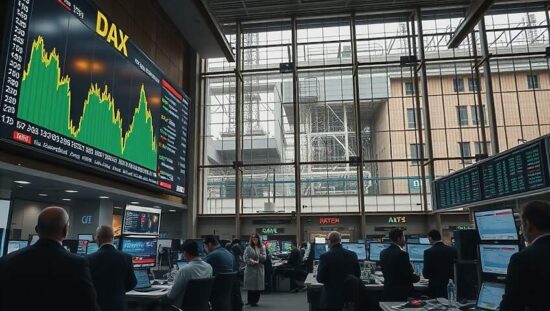
The DAX opened weaker on Friday. By 9:30 a.m., the index was calculated at about 23,315 points, 1.2 % below yesterday’s closing level.
Consorsbank’s chief market analyst Jochen Stanzl said the two‑week‑old Iran conflict is now increasingly affecting Germany’s economy. “We’re looking at inflation, growth, and valuations. A quick solution isn’t in sight, nor is a safe return of shipping traffic through the Strait of Hormuz. Global oil inventories-both commercial and strategic-are shrinking fast, leaving less room for additional shocks each day” he explained.
He warned that the longer the strait remains blocked, the more sensitively oil prices will respond. “If the Strait of Hormuz stays closed, there will come a day when prices rise above $120 and can’t be stopped. The market loses its buffer. In the climax, there will be little choice but to push the stockpiled oil through the passage-even if that means risking Iranian fire”.
Stanzl stressed that the first casualty of any war is truth. “The Strait of Hormuz remains uncertain: are mines laid or not? Answers depend on the source. Investors are fishing in murky waters. The truth we know is that oil tankers are burning. Once again a day begins when nothing comes out of the Persian Gulf-no oil, no LNG, no helium, no fertilizer, all the goods that keep the world’s economy moving. It looks as though the passage through the Strait of Hormuz will be attempted with military aid through an active war zone, and clear signs of de‑escalation are still elusive”.
He highlighted the far‑reaching effects of the strait’s closure. “Every day, the implications become clearer. Helium is one example. Qatar can no longer supply it; the country accounts for about 40 % of global supply. Helium is needed in Taiwan and South Korea for cooling lithography machines that manufacture high‑end chips. There’s no substitute. Existing stocks last roughly three months. While North America supplies almost half of worldwide production and could step in, the region itself needs the gas. A helium shortage would force a halt in chip production, push prices up, and slow the megascale expansion of AI data centers”.
Stanzl noted Taiwan’s energy context. “Taiwan, like Germany, shut down all nuclear plants and relies on gas plants for baseload generation. Those gas supplies were contracted through Qatar, which is now out of the picture. Taiwan must look to the spot market, similar to Europe or other Asian countries. This will drive up prices and could delay deliveries. For a country that only stores LNG for ten or eleven days, this is a serious problem”.
He added a further risk: “Taiwan is home to TSMC, one of the world’s largest chip producers. Reducing gas plant output to save LNG puts the grid’s risk buffer at a critical level. Voltage fluctuations or even outages could occur. TSMC’s lithography machines react to millisecond‑scale voltage swings with a shutdown, potentially causing millions‑of‑dollar‑worth damage. Because of global supply chain interdependence, a prolonged Iran war harms not only developing economies but also advanced economies whose supply chains could soon be disrupted”.
The euro weakened early on Friday, trading at $1.1438 (or €0.8743 per US dollar). Gold fell, with a refined ounce selling for $5.068, down 0.5 % and priced at €142.45 per gram. Meanwhile, the price of Brent crude rose noticeably; at 9 a.m. German time it was $102.10 per barrel, a 1.7 % increase from the previous day’s close.