




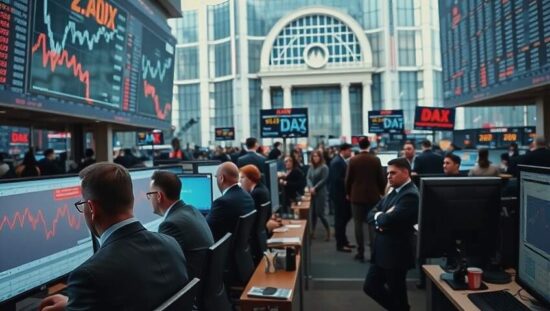
The DAX posted a loss on Thursday. At the close of the Xetra trading session, the index was measured at 24,491 points, down 0.5 percent from the previous day’s close.
Christine Romar, Head of Europe at CMC Markets, said: “Just as the DAX has been running ahead of the hoped‑for economic stimulus in recent months, it is difficult for investors to buy the now surprisingly positive indicators, such as the order inflows reported today”. She added that German industry might finally move past the bottom of the trough with the largest monthly contract surplus in two years.
Romar noted that the government’s special fund seems to be starting to take effect. “While other indicators in recent weeks sent mixed signals, a look at the full industrial order books is clear. Those orders just need to be processed, and the economic engine can step up”. She pointed out that the market and the economy have often moved in opposite directions over the past two years of muted growth. When the economy was at the bottom, the DAX hit record highs; now the mood is improving while the equity market is turning lower.
She explained that the pressure on Wall Street is mainly affecting high‑weighted favorites, the “Magnificent Seven”. Even solid quarterly results are being sold off because investors fear that too much investment is being directed toward AI, which has not yet yielded rapid monetisation. Anything that carries risk-most notably the cryptocurrency market and, in particular, Bitcoin-has accelerated its downward spiral, tightening the chain of liquidations.
“The DAX cannot escape this sell‑off and will have to abandon the 25,000‑point level it briefly skated over on Tuesday as a short‑term target. The apparent breakout turns out to be a classic bullish trap. Now the still‑young 2026 market faces its first serious test. If the markets cannot at least stabilise in the coming days, even long‑term investors will likely throw in the towel” Romar warned.
The euro weakened on Thursday afternoon. One euro bought 1.1789 US $ and one US dollar was worth 0.8482 EUR.
Gold was in a steep decline. In the afternoon it traded at $4,857 per troy ounce, down 2.2 percent, or 132.45 EUR per gram.
Oil fell sharply as well. By about 5 p.m. German time, a barrel of North Sea Brent was trading at $67.35, 21.1 cents (3.0 percent) lower than the previous day’s close.