




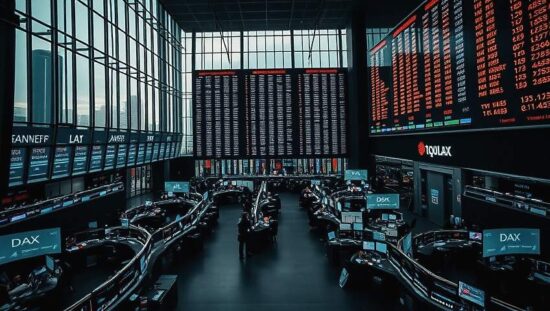
30 a..m. This was roughly 0.3 percent below Friday’s closing figure. The strongest performers at the top of the index were SAP, RWE and Deutsche Telekom, while Zalando, Airbus and Continental found themselves at the bottom of the list.
Chief market analyst Jochen Stanzl of Consorsbank said that in the last four weeks the markets have already priced in a short‑term conflict in the Middle East. With the Houthi militia’s entry into combat over the weekend and an increasing likelihood of U.S. ground troops being deployed, investors now face the growing risk of a prolonged war. Stanzl added that the sharp losses seen on Friday signal a capitulation among bullish investors, and that the market is now hoping for confirmation from Iran that talks with the United States are actually underway.
According to Stanzl, the stock exchanges have already priced in a mild slowdown of growth, conditional on Brent oil remaining around $100 a barrel. What the market has not yet fully accounted for is a significant downward revision of both growth and inflation forecasts, similar to the shift seen on “Liberation Day”. Such a risk would materialise if oil prices sustainably rise above $120. Historically, extended phases at that level have been accompanied by 15-20 percent stock market pullbacks.
Stanzl also noted that a persistent disruption in the Strait of Hormuz at a Brent price of $120 would not, by itself, trigger a recession. However, if oil stays in the $100-120 band for several months while fiscal relief measures for consumers are also in place, the risk moves toward a stagflationary environment. This could force central banks to raise rates, a scenario that recalls the 2022 period and its negative impact on equity markets.
Conversely, Stanzl pointed out that an abrupt and sharp spike to above $150 would make a recession highly probable. In that situation, interest‑rate hikes would no longer be the primary concern; instead, a demand shortfall would press oil prices downward. The key for markets is not just the level of such a shock but its duration. A rapid de‑escalation and resumption of oil traffic through the Strait of Hormuz would likely elicit a positive market response.
The euro remained largely unchanged in the morning. One euro traded at 1.1502 U.S. dollars, while one U.S. dollar was equivalent to 0.8694 euros.
Meanwhile, the oil price rose sharply. At around 9 a.m. German time, a barrel of North Sea Brent was priced at $115.80, up 2.9 percent from the previous session’s close.