




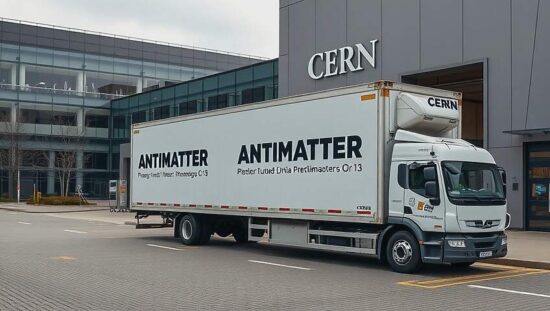
At CERN in Geneva, antiprotons were transferred by truck for the first time on Tuesday, according to a statement from the University of Düsseldorf’s Heinrich‑Heine, where Stefan Ulmer, the director of the BASE experiment, is based.
Ulmer explained that catching and storing antiprotons over long periods is challenging. “Antimatter annihilates immediately when it comes into contact with matter. Therefore the antiparticles must be confined by electric and magnetic fields in an extremely high vacuum so that they do not touch gas molecules or the storage vessel” he said.
The antiprotons were produced at CERN’s “Antimatter Factory” the only facility in the world capable of delivering such particles at very low energies. The BASE team collected roughly one hundred antiprotons in an 850‑kg trap, using magnetic and electric fields to hold them. The trap was then isolated from the main experimental station, loaded onto a truck, driven across the CERN campus, and re‑connected to the experiment once again.
This truck‑based transport marks a first step toward sending antimatter to other European laboratories, where measurements can be carried out in environments with reduced background disturbances.