

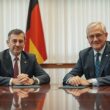



The Christian Democratic Union’s (CDU) leading candidate for the upcoming state election in Saxony-Anhalt, Sven Schulze, has launched a blistering attack on the Alternative for Germany (AfD), dismissing their policy proposals as “zero” and asserting the possibility of a CDU majority. In an interview with “Stern” magazine, Schulze directly challenged the AfD’s simplistic narratives, specifically their claim that Germany would be free from its current challenges without the presence of migrants – a statement he characterized as a “lie.
Schulze, a member of the CDU’s federal executive and currently serving as Economics Minister in Saxony-Anhalt, underscored his unequivocal rejection of any potential coalition with the AfD. He framed the September 6th election not as a referendum on Chancellor Scholz’s federal government, but as a critical choice determining Saxony-Anhalt’s capacity for effective governance. Schulze warned that allowing the AfD to gain significant influence would plunge the state into chaos due to their perceived lack of substantive policy expertise.
He pointed to the AfD’s recent opposition to federal funds from the infrastructure special fund – representing a significant €2.6 billion investment – as a stark example of their “inability”. Schulze vehemently stated his refusal to allow Saxony-Anhalt to become “an experimental field” for the AfD’s untested ideas. He characterized the party as a “hollow shell” driven by the ideology embodied by its top candidate, Ulrich Siegmund. The prospect of a coalition with either the AfD or the Left party has been categorically ruled out, with Schulze expressing discomfort at the prospect of serving alongside members of either party in his cabinet.
Despite currently trailing the AfD in opinion polls – with the latter commanding nearly 40 percent of the potential vote – Schulze remains optimistic about the CDU’s prospects. He voiced a clear ambition to lead the CDU to victory and secure a majority government, deeming this outcome “realistic”. However, current polling data suggest that Schulze would require the support of the Left party to achieve the position of Minister-President, highlighting the complex political landscape facing Saxony-Anhalt as it heads towards the election. The sharp rhetoric raises questions on whether Schulze’s aggressive strategy will be effective in closing the poll gap and shifting voter sentiment.