


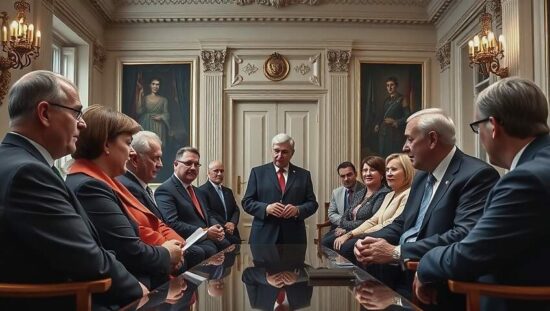
During the recent meeting involving the CDU, CSU, and SPD at the Villa Borsig in Berlin, underlying conflicts were reportedly much deeper than previously understood. According to the newspaper Spiegel, reports cited by multiple coalition members indicated that discussions even reportedly teetered on the edge of being halted and postponed at the Tegeler See. However, coalition sources stated that because all parties realized they could not come before the public without a signal of financial relief, they ultimately managed to reach an agreement.
Both sides, the report noted, expressed criticism of the negotiating tactics employed by their respective coalition partners. During talks reported by “Bild” the Union proposed reducing sick pay and introducing a mandatory day off. These demands were deemed unacceptable by the SPD, with the request being viewed as provocative. Furthermore, the Union had reportedly hinted at eliminating the statutory public holiday on May 1st, which the Social Democrats perceived as an insult. According to the magazine, the SPD also claims that negotiations concerning an income tax reform were advanced and abruptly halted by the Union.
Conversely, it was reported that the SPD was unwilling to make concrete commitments regarding the healthcare reform to the degree the Union desired. From the Union’s perspective, the SPD’s insistence on a windfall tax for mineral oil corporations unnecessarily complicated the negotiations, with suggestions that the SPD was driven more by party factions and trade unions.
The SPD, according to Spiegel, maintained that there had been a commitment from Federal Chairman Friedrich Merz (CDU): that the SPD would support a windfall tax if the EU approved a similar regulation. This compromise was ultimately incorporated into the negotiated outcome.
Regarding the reasons for the meeting’s protracted and difficult progress despite extensive preparation, the report highlighted differing accounts within the coalition. The SPD attributed the difficulty to what it termed a “political management problem” with its coalition partner, suggesting that the coordinating bodies or party leaders at the other level were unaware of certain arrangements.
The Union, however, rejected this criticism. They argued that the process itself was structured to ensure every party remained fully informed at all times. The detailed nature of the negotiations, which included the round known as the Sherpa Round-attended by CDU official Thorsten Frei, SPD finance minister Björn Böhning, and CSU interior minister Alexander Dobrindt-was said to account for the depth of the coalition negotiations. They maintained that every aspect was prepared, making any claim of lack of coordination unfounded.
Over the course of the weekend, the leaders of the CDU, CSU, and SPD consulted in various groupings at the Villa Borsig, the Federal Foreign Office’s guest house. The topics covered included reforms of social systems, budget cuts for the federal budget, and relief measures for citizens facing the energy crisis. After nearly 24 hours of deliberations, the party chairmen presented a three-way agreement on Monday. This agreement’s main components included a temporary reduction in energy taxes on diesel and gasoline, and the option for employers and employees to arrange a tax- and social security-free relief bonus of 1,000 euros.