




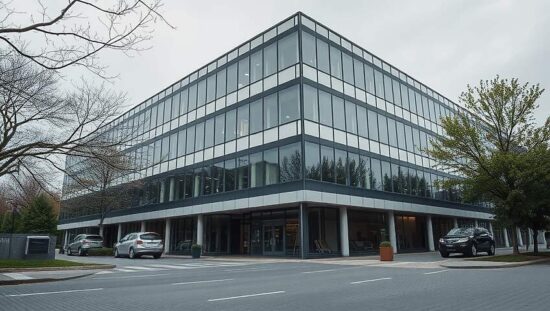
A significant contraction in office space demand is looming in Germany, potentially exacerbating existing vacancies and forcing a re-evaluation of urban planning strategies. A new survey, conducted by Trend Research Hamburg on behalf of Berlin-based commercial real estate firm GSG and reported by Funke-Mediengruppe, reveals that nearly half (44%) of personnel decision-makers in Germany’s seven largest cities anticipate reducing their office footprint by between 20 and 40 square meters by 2030. The average projected reduction across respondents amounts to a substantial 27%.
The accelerating trend is directly linked to the proliferation of Artificial Intelligence (AI) and its impact on workforce structures. While full-time, mandatory office presence remains rare – only 30% of respondents currently enforce it – an average of just 70.2% of employees physically visit offices. This stark shift raises critical questions about the future of commercial real estate and its contribution to urban economic vitality.
The Federal Ministry of Housing, Urban Development and Building has responded by advocating for the conversion of vacant office spaces into residential units. Parliamentary State Secretary Sören Bartol argues that such transformations offer a solution to strained housing markets, particularly in densely populated areas where land is scarce. He also highlights the potential for significant CO2 emission reductions compared to new construction, with the government planning financial incentives to facilitate these conversions from this summer. However, Bartol acknowledges the cultural hurdle of fostering a “renovation culture” among developers, architects and project managers, who are presently often incentivized to demolish rather than repurpose existing buildings.
The practicality of large-scale conversions is facing significant headwinds. Aygül Özkan, Managing Director of the Central Committee for Real Estate (ZIA), emphasizes that prohibitive costs, driven by protracted approval processes and bureaucratic complexity, frequently derail renovation projects. She contends that streamlining regulations and reducing delays are essential to unlock the potential for adaptive reuse.
Despite the challenges, Özkan remains optimistic about the long-term survival of the office, but insists a radical rethink is paramount. She argues that the modern office must evolve beyond a simple provision of space, becoming an integrated component of corporate culture-an attractive environment that actively encourages employee presence, rather than a mandated obligation.
The survey, commissioned by GSG and involving 502 personnel decision-makers in Berlin, Frankfurt, Hamburg, Cologne, Dusseldorf, Munich and Stuttgart, indicates a deeper systemic shift than simple budgetary adjustments. It underscores the urgent need for policymakers and the real estate sector to actively collaborate on innovative solutions to navigate the evolving landscape of work and urban development, lest vacant office towers become a lasting symbol of economic and social disruption.