



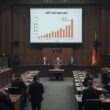

The German parliament’s budget committee chair, Lisa Paus of the Green Party, is advocating for a dedicated federal law to authorize the provision of up to €140 billion in loans to Ukraine, derived from frozen Russian assets. This stance underscores the complex legal and political hurdles confronting the EU’s ambitious plan to financially support Kyiv.
The European Council, comprised of heads of state and government, is scheduled to deliberate on the utilization of these assets this Thursday. Paus’s statement to the Redaktionsnetzwerk Deutschland clarifies that a national law will be indispensable should the Council reach an agreement. “If the Council agrees on Thursday, a national law for the guarantee is naturally, correctly and understandably necessary” she explained, adding that detailed negotiations are ongoing, but implementation is unlikely before the new year.
Ukraine’s projected financial needs until the end of 2027 are estimated at €135.7 billion. The funds currently held by the European Union, belonging to the Russian Central Bank, total up to €210 billion.
Paus’s call for a specific law signals a growing recognition of the contentious legal landscape surrounding the proposal. While the initiative is presented as a unified response to Ukraine’s urgent needs, the framework for accessing and utilizing these frozen assets remains deeply intertwined with complex legal interpretations and potential challenges to national sovereignty. Critics have already raised concerns regarding the legality of seizing Russian assets, questioning the precedent it sets for international finance and the potential for retaliatory measures from Moscow.
The delayed implementation, as indicated by Paus, suggests internal discussions within the German government are still grappling with the political and legal ramifications of enacting such legislation, foreshadowing a potentially protracted and politically charged process. The proposed timeline also raises questions about the immediacy of support for Ukraine, highlighting the disconnect between the urgency of the situation on the ground and the legislative procedures required to address it.