




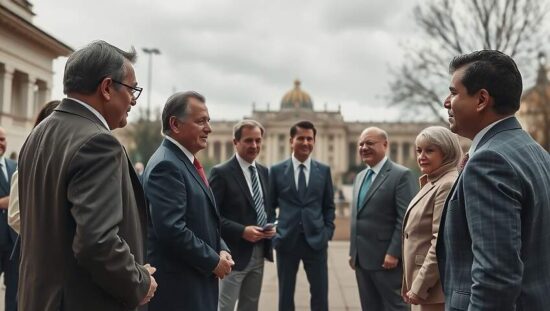
The transatlantic relationship faces a seismic shift as the new US security strategy, championed by President Donald Trump, signals a fundamental abandonment of decades-long support for Europe, according to prominent German politician Norbert Röttgen. Speaking at the Doha Forum, Röttgen characterized the policy as a “second turning point” in history, marking the first time since World War II that the United States is distancing itself from European interests, including a critical stance towards Ukraine facing an illegal and brutal war.
Beyond the immediate geopolitical ramifications for Ukraine, Röttgen voiced deep concern over the strategy’s explicit intention to interfere in the internal affairs of European states. He alleges that the US aims to influence Europe’s constitutional framework, aligning it with the ideological tenets of the “MAGA” movement and notably, fostering alliances with forces deemed internal adversaries to liberal democracies within Europe – singling out the Alternative for Germany (AfD) as a potential partner. This represents a profound reversal of the political foundations upon which Europe has been built for 80 years, with Röttgen warning that the strategy’s success could ultimately lead to the dissolution of the European Union.
The sentiment of disappointment, Röttgen insists, scarcely captures the magnitude of the change. He underscored the indispensable role US policy played in shaping the transatlantic alliance, fostering liberal democracy, nurturing the social market economy and achieving German reunification. “These are the cornerstones of our political existence” he stated, accusing the current US administration of reversing this foundational relationship.
Europe finds itself increasingly positioned between a geopolitical vise, facing Russian aggression and now, an internal pressure exerted by Washington. Röttgen articulated the urgent need for Europe to assert its sovereignty, pointing specifically to the EU Council’s upcoming decision on December 18th regarding the economic utilization of frozen Russian assets. He framed this decision not merely as an economic measure, but as “a necessary expression of our will to assert ourselves” a message directed explicitly to both Moscow and Washington. Crucially, he emphasized that such a decision must include the necessary financing of Ukraine’s defense capabilities, laying the groundwork for a lasting political resolution. The survival of European sovereignty, according to Röttgen, now hinges on this bold and self-determined course of action.