




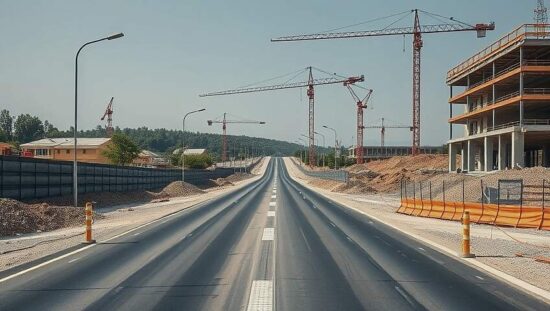
The German Federal Ministry of Transport has authorized the commencement of construction on 16 federal highway projects and seven new Autobahn (motorway) expansions across the nation, marking a significant and potentially controversial, acceleration of infrastructure development. Minister for Transport, Patrick Schnieder (CDU), formally notified his state-level counterparts of the approvals in Berlin earlier this week, accompanied by a reported investment of approximately €4.3 billion.
While the ministry touts the move as a demonstration of commitment to Germany’s vital road network, the timing and scale of the release have drawn scrutiny amidst ongoing debates surrounding the nation’s climate goals and the prioritization of highway construction over sustainable transport alternatives. The decision comes shortly after the coalition government approved an additional €3 billion for the maintenance of bridges and tunnels within the Bundesfernstraßen network, spanning the years 2026 to 2029.
The projects, impacting Baden-Württemberg, Bayern, Brandenburg, Hessen, Mecklenburg-Vorpommern, Niedersachsen, Nordrhein-Westfalen, Rheinland-Pfalz, Sachsen, Sachsen-Anhalt, Schleswig-Holstein and Thüringen, will funnel around €710 million into federal highway projects and a substantial €3.6 billion into Autobahn upgrades.
Schnieder’s assertion – “We are sending a strong signal for our country, especially for our important network of federal highways” – has been met with a nuanced response. Critics argue that prioritizing extensive road expansion contradicts Germany’s legally binding commitment to reduce greenhouse gas emissions and shift towards a more environmentally friendly transport system. The “ready-to-build will be built” policy, while presented as efficient, has raised concerns about a potential lack of rigorous environmental impact assessments and a failure to adequately consider alternative solutions.
Furthermore, questions are being asked about the allocation of funds, with some regional stakeholders expressing doubts about the fairness of the distribution across the federal states and arguing that certain projects have been prioritized over others deemed more strategically important for regional development and connectivity. The rapid advancement of these projects also leaves open the possibility of cost overruns and delays, mirroring experiences with previous large-scale infrastructure initiatives. The long-term implications of such a large-scale highway expansion remain a focal point of political and public debate.