




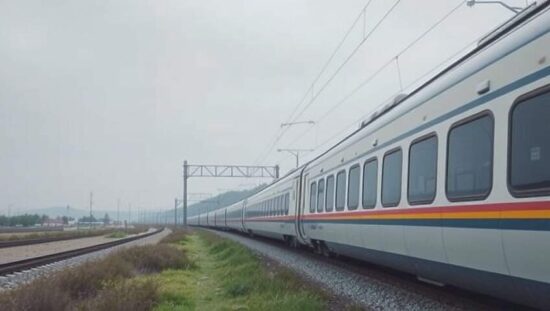
Germany’s ambitious “Mobility Transition” (Verkehrswende), repeatedly touted by policymakers, is facing a stark reality check as infrastructure development reveals a concerning divergence in priorities. A recent analysis by the Frankfurter Allgemeine Sonntagszeitung, based on government investment reports and data from Deutsche Bahn, reveals that the construction of new railway lines has dwindled to levels not seen since the dawn of Germany’s high-speed rail era in 1991.
Since 2016, a mere 240 kilometers of long-distance railway lines, primarily intended for ICE high-speed train services, have been brought into operation. This pales in comparison to the roughly 350 kilometers completed between 2006 and 2015 and the nearly 500 kilometers finished during the period from 1996 to 2005. The previous decade saw even more impressive figures, exceeding 400 kilometers of new track. The recent pace underscores a critical bottleneck in Germany’s attempts to shift transportation away from road-based transport.
Simultaneously, road construction has seen a significant push. Approximately 250 kilometers of new highways have been opened since 2016, alongside a further 363 kilometers expanded with additional lanes. Hundreds of kilometers of new federal roads have also been added, often built with four or two lanes specifically catering to long-distance traffic. This suggests a fundamental disconnect between declared policy goals and concrete investment choices, raising questions about the genuine prioritization of rail over road.
Even the expansion of Germany’s road network has slowed considerably when compared to previous decades. The pace of new highway construction since 2016 has been halved compared to the period before. The frequent construction of over 100 kilometers annually, common until 1992, is now a distant memory, especially when considering the nearly 400 kilometers of new roads delivered yearly in the 1970s.
Despite the establishment of a special asset fund allocated hundreds of billions of euros for infrastructure, a true “Mobility Transition” in terms of new construction projects appears unlikely. Currently, only 140 kilometers of new highways are under construction – a figure dwarfed by the comparatively meager 40 kilometers of new railway lines planned. Vital projects such as the Frankfurt-Mannheim, Frankfurt-Fulda and Hannover-Hamburg lines, discussed for decades, remain stalled without even a confirmed start date. The Rheintalbahn, a critical artery for European freight traffic, is now slated for a second pair of tracks only by 2040.
Responding to inquiries from the Frankfurter Allgemeine Sonntagszeitung, the Ministry of Transport stated that current increased rail investments are predominantly focused on maintaining the existing railway network, a tacit acknowledgement that significant expansion efforts remain elusive. This prioritization reveals a structural impediment to the proclaimed shift towards sustainability and prompts serious scrutiny of the government’s commitment to a genuinely balanced and forward-thinking transport policy.