




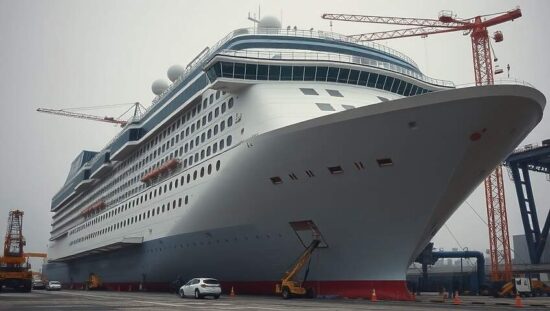
The Meyer Werft shipyard, recently stabilized by significant government intervention, has secured a landmark order from MSC Cruises, signaling a potential lifeline for the embattled German shipbuilding giant. A “Letter of Intent” was formally signed Monday at the Federal Ministry for Economic Affairs and Climate Action, outlining a commitment for the construction of four to six cruise ships valued at up to €10 billion. The agreement, which is projected to keep the shipyard in Papenburg operational until 2035, arrives after a tumultuous period marked by pandemic-induced disruptions and the cascading economic effects of the war in Ukraine.
The federal government and the state of Lower Saxony jointly stepped in late last year to prevent the shipyard’s collapse, assuming a majority stake in Meyer Werft GmbH and guaranteeing a substantial credit framework of €2.6 billion. This intervention represents a considerable commitment of public funds, raising questions about the long-term sustainability of such large-scale government involvement in the private sector.
Economic Affairs Minister Katheine Reiche (CDU) hailed the MSC Cruises order as a “decisive breakthrough” framing it as a testament to German engineering prowess and international confidence. However, critics argue that the situation highlights a deeper structural issue within the German shipbuilding industry-a reliance on massive cruise ship contracts and a vulnerability to global economic shifts. The extent to which this new order can truly overcome the foundational problems which led to the shipyard’s precarious position remains to be seen.
The “Letter of Intent” is not a binding contract and further negotiations are required. The agreement also underscores the political sensitivity surrounding the Meyer Werft case. The joint ownership by the federal government and Lower Saxony creates a complex dynamic, with potential for political interference in operational decisions and scrutiny over the allocation of taxpayer money. While the deal appears to secure immediate jobs and maintain crucial industrial expertise for Germany, the long-term implications of this state-backed rescue deserve careful and ongoing evaluation.