




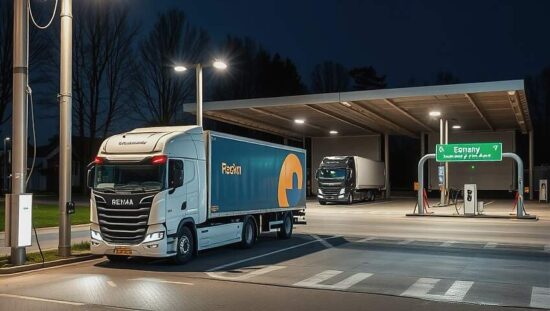
The European Commission has approved a significant €1.6 billion state aid package for Germany’s development of truck rapid-charging infrastructure at Autobahn rest areas, marking a potentially transformative, yet politically fraught, step towards electrifying the nation’s heavy goods transport sector. The decision, announced by the Federal Ministry of Transport, clears the path for the concrete implementation of public rapid-charging points for battery-electric trucks on federal land.
While lauded by Transport Minister Patrick Schnieder (CDU) as creating “a reliable entry point into public charging for heavy e-trucks” the move highlights a broader and increasingly critical, debate surrounding the transition to electric mobility in Germany’s crucial logistics industry. The focus on initially deploying infrastructure at unmanaged rest areas, while expedient for immediate progress, raises questions about the long-term viability and accessibility of the network. Critics argue that solely relying on federal land risks neglecting the needs of private operators and potentially creating an uneven distribution of charging points.
The partnership involving the Autobahn GmbH des Bundes, the Nationale Leitstelle Ladeinfrastruktur and the NOW GmbH, while framed as a streamlined approach, also introduces complexities regarding responsibility and coordination. Concerns have been voiced questioning whether the government-led approach sufficiently incentivizes private sector investment, a vital component for scaling the network beyond the initial phase.
Beyond the practical considerations, the decision also reflects a strategic political maneuver by the CDU-led government. By initiating development on federal land, the government asserts direct control over a key element of the electric truck transition, potentially buffering against accusations of slow progress and positioning the state as a proactive driver of change. However, this centralized approach may also face resistance from industry representatives who favor a more decentralized and market-driven model.
The long-term success of this project hinges not only on the logistical challenges of building out the charging infrastructure, but also on navigating the delicate balance between governmental control and private sector innovation in a sector critical to Germany’s economy.