




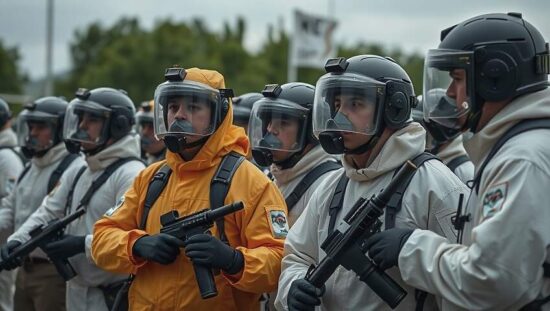
The German Ministry of Defence is planning a significant expansion of protective equipment provisions, extending beyond active military personnel to encompass all 80,000 civilian employees and officials within the Bundeswehr and its affiliated departments. A confidential draft presented to the Bundestag’s budget committee, as reported by “Der Spiegel”, reveals Defence Minister Boris Pistorius’ intention to equip this vast workforce with body armor and combat helmets – a measure unprecedented since the Cold War.
The rationale behind this escalation in security measures centres on bolstering “operational readiness in the event of an emergency”. The ministry asserts this is a “consistent realignment” of the Bundeswehr to meet the demands of national and alliance defense, reflecting a palpable shift in threat perception and strategic priorities. Deployment will occur incrementally over the coming years, although precise financial implications remain undisclosed within the parliamentary document.
This workforce includes a broad spectrum of personnel, ranging from officials within the Defence Ministry itself to employees of procurement agencies, technical services and thousands of technicians and administrative staff. Previously, only a fraction of this segment of the Bundeswehr had received robust protective gear.
The 80,000 helmets and body armor represent a component of a multi-billion euro procurement package triggered by ambitious plans to dramatically expand the Bundeswehr. Minister Pistorius’ ministry has already requested an additional €21 billion to outfit not just new recruits but also reservists and conscripts, a vast increase from previously budgeted funds of around €10 billion for soldier equipment.
The proposed force structure aims to grow the active military to 265,000 personnel by 2035, coupled with an estimated 200,000 individuals within a standing reserve – a scale necessitating the provision of a substantial and continuous supply of equipment. Internally dubbed “Project Fiber” (short for “Field Equipment Soldier / Expanded Reserve”), this massive gearing-up initiative highlights a profound and accelerating commitment to military expansion.
Furthermore, the procurement package incorporates provisions for the anticipated influx of conscripts, with the Ministry citing “short turnaround times” as contributing to a “significant increase in the number of equipment provisions”. The need for higher quality standards during the outfitting of new recruits is also explicitly cited as a driver for increased expenditure, prompting questions regarding cost-effectiveness and whether existing procurement processes are adequately equipped to handle such a massive and rapid expansion. The move inevitably sparks debate regarding the normalization of militarization within German society and the potential ramifications for civil liberties.