




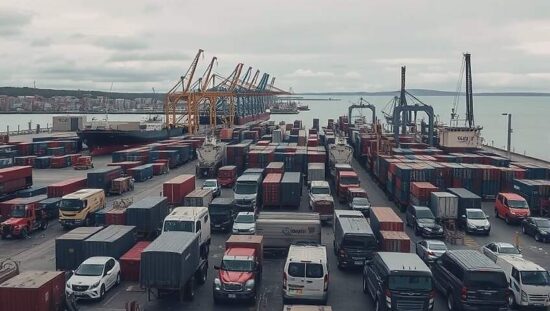
Germany’s export sector faces a bleak outlook extending into 2026, according to a recently released study supported by the Foreign Office and conducted by the pro-business Institute for German Economics (IW). The findings, published in the Handelsblatt, paint a concerning picture of diminishing German market share on the global stage, despite mitigating factors.
While counterbalancing effects have so far prevented a complete collapse of goods exports, the study warns of a continued erosion of Germany’s international competitiveness. Exports to the United States have already plummeted by nearly eight percent in the first three quarters of this year compared to the previous year, while those to China have fallen by a staggering twelve percent. These declines collectively dragged down overall German exports by over 1.5 percentage points, with the US contributing 0.81 points and China 0.74 points of the shortfall. Increased exports within Europe have partially offset these losses, but real exports have still contracted by 0.7 percent.
The prognosis for China appears particularly grim. The IW study conveys a pessimism regarding a sustained rebound in exports to the nation, citing China’s accelerating technological advancement and a deliberate push towards economic self-sufficiency. The report suggests that China’s reliance on unfair trade practices presents a formidable obstacle, rendering appeals for improved market access for EU exports largely ineffective.
This assessment has fueled a growing debate within German economic circles regarding protectionist measures. IW economist Jürgen Matthes argues for the justification of safeguarding European industries threatened by Chinese competition through the implementation of trade barriers. The research suggests a strategic pivot towards bolstering intra-European trade as a crucial avenue for revitalizing German exports.
Furthermore, the institute strongly urges the European Union to prioritize negotiations with the United States to reduce, or entirely remove, the high tariffs imposed on processed steel and aluminum products. Failure to do so, the study cautions, will almost certainly result in further losses in German exports to the American market next year. The recommendations signal a growing acknowledgement within German policy circles that a protracted reliance on traditional export markets may necessitate a more assertive and potentially confrontational approach to international trade relations.