




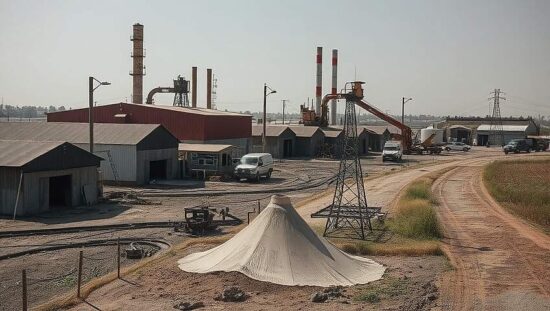
A major industrial facility in Baden-Württemberg is suspected of releasing significant quantities of sulfur hexafluoride (SF6), a potent greenhouse gas, far exceeding previously reported figures. Investigative reporting by “Der Spiegel” and ZDF revealed that atmospheric scientists at the University of Frankfurt believe that a chemical plant operated by a major corporation in the spa town of Bad Wimpfen is the primary source of the emissions.
SF6 is considered one of the most harmful substances ever created by humankind. Though odorless, colorless and non-toxic to humans, a single kilogram has a global warming potential 24 times higher than that of carbon dioxide (CO2) over a 100-year period.
The corporation reported an SF6 emission of just 56 kilograms for the Bad Wimpfen site in 1993 – a figure now widely considered to be a substantial underestimation. Scientists at the University of Frankfurt estimate average annual emissions of approximately 30 tons of SF6 in Southwest Germany between 2020 and 2023. This translates to the equivalent of 729,000 tons of CO2 annually, comparable to the yearly emissions of over 250,000 internal combustion engine sports cars or the entirety of inner-German air traffic. If these figures are accurate, a significant portion of all German SF6 emissions could be attributable to the facility in Bad Wimpfen.
Responding to inquiries from the media outlets, the corporation stated it had implemented “all necessary, scientifically grounded measures” to evaluate and continuously monitor the situation, offering no clarity on the total quantity of SF6 believed to have been released.
The Frankfurt researchers alerted authorities in 2023 to the disproportionately high levels of SF6 leakage detected in the Heilbronn district. This prompted multiple meetings involving the Hessian and Baden-Württemberg environmental ministries, the researchers and the company representatives.
The Baden-Württemberg Ministry for the Environment, headed by Green Party politician Thekla Walker, acknowledged the Frankfurt study but dismissed its ability to definitively link the emissions to the specific industrial plant. The ministry appeared hesitant to attribute the SF6 emissions solely to the facility, initially claiming the region possessed a “variety of users” of the gas, including energy providers and power plants. This argument, however, faltered when, pressed for clarification, the ministry conceded that these alternative sources had been ruled out.
Despite the assertions and investigations, atmospheric scientist Andreas Engel reported that elevated SF6 contamination remains visible. “We continue to observe a strikingly high level of SF6 pollution” Engel stated, raising serious concerns about the effectiveness of regulatory oversight and the potential for long-term environmental damage. The incident has ignited a political debate, with critics questioning the government’s responsiveness and demanding greater corporate accountability in addressing climate-altering industrial practices.