




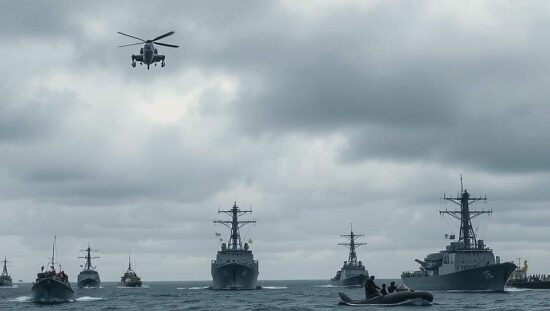
Beijing has announced extensive military exercises encircling Taiwan, escalating tensions in the region and drawing condemnation from Taipei. The maneuvers, dubbed “Justice Mission 2025” are framed by the People’s Liberation Army (PLA) as a “serious warning” directed at proponents of Taiwanese independence and perceived external interference. The timing of the exercises, coupled with recent diplomatic clashes and a substantial US arms deal with Taiwan, underscores the increasingly confrontational dynamic across the Taiwan Strait.
The PLA stated the exercises are intended to assess combat readiness, alongside the capability to blockade and control key ports and strategically important areas around Taiwan. Live-fire drills are planned across five designated maritime and air zones, a clear demonstration of Beijing’s military capabilities and a signal intended to intimidate.
Taiwan’s government has sharply criticized the drills, accusing Beijing of employing military coercion. Taipei’s Defense Ministry confirmed a heightened state of alert, with preparations underway for rapid response counter-exercises. While standard procedure, the scale and messaging surrounding “Justice Mission 2025” are particularly provocative, reflecting a hardening stance from Beijing.
The exercises are occurring against a backdrop of already strained relations. A recent diplomatic dispute between China and Japan, triggered by comments regarding Taiwanese sovereignty, adds another layer of complexity to the regional security landscape. Moreover, Washington’s recent confirmation of a major arms sale to Taiwan – significantly bolstering Taipei’s defense capabilities – is almost certainly a factor contributing to the timing and intensity of Beijing’s response.
China’s longstanding claim over Taiwan and its explicit commitment to using force if necessary to achieve unification remain a central point of contention. The increasingly frequent and expansive nature of these military drills reflects a deliberate strategy of heightened pressure aimed at coercing Taiwan and deterring potential intervention from external powers, particularly the United States. Critics argue this escalatory tactic risks destabilizing the region and pushing the international community closer to a crisis point, demanding a careful recalibration of diplomatic approaches to de-escalate the situation and prevent miscalculation.